M5Stack CoreS3
ESP32-S3 based Core series device with 2.0" 320x240 IPS display, capacitive touch, AXP2101 PMU, AW9523 I/O expander, internal BMI270 IMU, ES7210 microphone codec, speaker amp, microSD slot, and multiple Grove/M-Bus ports.
Product Images
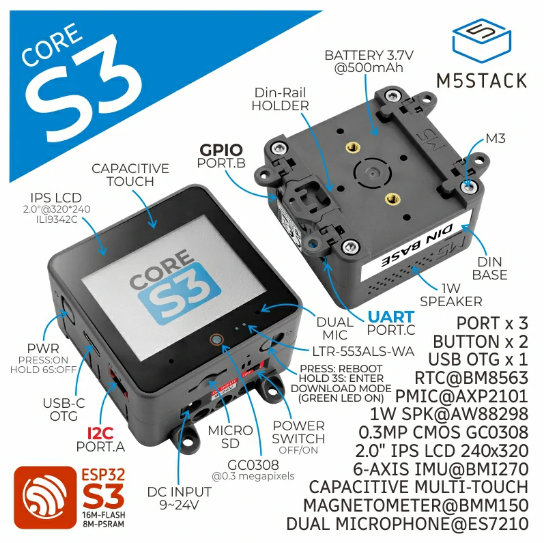
GPIO Pinout
| Pin | Function |
|---|---|
| GPIO3 | Display CS |
| GPIO35 | Display MISO / D-C (3-wire) |
| GPIO36 | Display/SPI SCLK |
| GPIO37 | Display/SPI MOSI |
| GPIO4 | microSD CS (shares SPI bus) |
| GPIO21 | Touchscreen IRQ |
| GPIO12 | Internal I2C SDA (PMU, touch, IMU, AW9523) |
| GPIO11 | Internal I2C SCL |
| GPIO2 | Grove Port A SDA |
| GPIO1 | Grove Port A SCL |
| GPIO9 | Port B |
| GPIO8 | Port B |
| GPIO18 | Port C |
| GPIO17 | Port C |
| GPIO0 | I2S MCLK (microphone codec) |
| GPIO14 | I2S DATA IN (microphone codec) |
| GPIO13 | I2S DATA OUT (speaker) |
| GPIO33 | I2S LRCK (mic + speaker) |
| GPIO34 | I2S BCLK (mic + speaker) |
Notes: LCD reset and backlight are driven by the AW9523 I/O expander, so no direct GPIO is exposed. Power rails and battery telemetry are handled by the AXP2101 PMU on the internal I2C bus.
External Components
ESPHome AXP2101 Component by stefanthoss
This component exposes battery voltage/level/charging state and lets you manage the CoreS3 power rails controlled by the AXP2101 PMU.
Example Configuration
Hardware-only starter configuration for the CoreS3 display, touch panel, and buses. Backlight and reset are managed by
the AXP2101/AW9523, so the display uses -1 pins for those signals.
substitutions:
  devicename: m5cores3
  upper_devicename: M5Stack CoreS3

esphome:
  name: ${devicename}
  friendly_name: ${upper_devicename}

esp32:
  board: esp32-s3-devkitc-1
  flash_size: 16MB
  framework:
    type: esp-idf
    ## Note: Disable these configurations if you face the boot loop issue.
    sdkconfig_options:
        CONFIG_ESP32S3_DATA_CACHE_64KB: "y"
        CONFIG_ESP32S3_DATA_CACHE_LINE_64B: "y"
        CONFIG_ESP32S3_INSTRUCTION_CACHE_32KB: "y"
        # Moves instructions and read only data from flash into PSRAM on boot.
        # Both enabled allows instructions to execute while a flash operation is in progress without needing to be placed in IRAM.
        # Considerably speeds up mWW at the cost of using more PSRAM.
        CONFIG_SPIRAM_RODATA: "y"
        CONFIG_SPIRAM_FETCH_INSTRUCTIONS: "y"

psram:
  mode: quad
  speed: 80MHz

logger:
  level: DEBUG

wifi:
  ssid: !secret wifi_ssid
  password: !secret wifi_password

  ap:
    ssid: ${upper_devicename} Fallback
    password: !secret wifi_password

captive_portal:

api:

ota:
  - platform: esphome

external_components:
  - source: github://m5stack/esphome-yaml/components
    components: [axp2101, aw88298, aw9523b ]

i2c:
  - id: bus_internal
    sda: GPIO12
    scl: GPIO11

spi:
  - id: spi_bus
    clk_pin: GPIO36
    mosi_pin: GPIO37

axp2101:
  id: axp2101_pmu
  i2c_id: bus_internal

# IO Expander
aw9523b:
  - id: aw9523b_hub
    i2c_id: bus_internal

output:
  - platform: axp2101
    type: range
    channel: DLDO1
    id: lcd_backlight_output
    min_voltage: 2600
    max_voltage: 3300

  - platform: axp2101
    channel: ALDO1
    voltage: 1800

  - platform: axp2101
    channel: ALDO2
    voltage: 3300

  - platform: axp2101
    channel: BLDO1
    voltage: 2800

  - platform: axp2101
    channel: BLDO2
    voltage: 1500
Display
touchscreen:
  - platform: ft63x6
    id: touch
    reset_pin:
      aw9523b: aw9523b_hub
      number: 0
    calibration:
      x_min: 0
      x_max: 320
      y_min: 0
      y_max: 240

display:
  - platform: mipi_spi
    model: M5CORE
    dc_pin: GPIO35
    reset_pin:
      aw9523b: aw9523b_hub
      number: 9
    cs_pin: GPIO3
    data_rate: 40MHz
    invert_colors: true
    id: m5cores3_lcd
    show_test_card: true

light:
  - platform: monochromatic
    id: lcd_backlight
    name: "LCD Backlight"
    icon: "mdi:television"
    entity_category: config
    output: lcd_backlight_output
    restore_mode: RESTORE_DEFAULT_ON
    default_transition_length: 250ms
RTC
# First block - component definition only
esphome:
  min_version: 2025.12.0

time:
  - platform: bm8563
    i2c_id: bus_internal
    # repeated synchronization is not necessary unless the external RTC
    # is much more accurate than the internal clock
    update_interval: never
# Second block - more complex example with on_boot
esphome:
  on_boot:
    then:
      bm8563.read_time:
time:
  - platform: bm8563
    i2c_id: bus_internal
    update_interval: never
  - platform: homeassistant
    on_time_sync:
      then:
        bm8563.write_time:
Notes
- Power: Use the AXP2101 external component to read battery status and enable rails like LCD/backlight if they are disabled by default.
- Audio: The ES7210 microphone and speaker amp share the I2S bus on GPIO0/13/14/33/34 if you want to add
i2s_audiocomponents. - Storage: The microSD slot shares the LCD SPI bus with CS on GPIO4.
- Expansion: Grove Port A exposes I2C on GPIO2/1; Ports B (GPIO9/8) and C (GPIO18/17) are free GPIOs on the M-Bus.
- Touchscreen: The FT63X6 capacitive touch controller requires a reset pin driven by the AW9523B expander (pin 0). The calibration values ensure proper coordinate mapping for the 320x240 display.
- IO Expander (AW9523B): This component manages LCD reset (pin 9), touchscreen reset (pin 0), and other peripheral power switches. It must be properly configured for the display and touch to function.
- IMU (BMI270): The built-in BMI270 6-axis IMU is not yet supported in ESPHome.
It is available on the internal I2C bus at address 0x68. - RTC (BM8563): ESPHome component exists for version >=2025.12.0.