
PUSR USR-EG118
Product Images
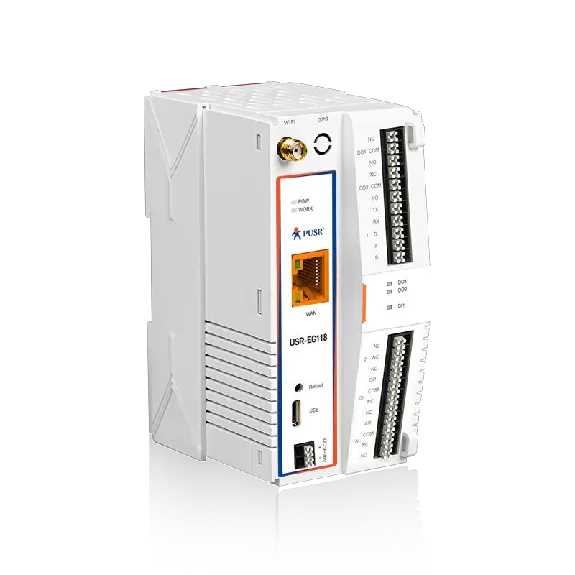
USR-EG118
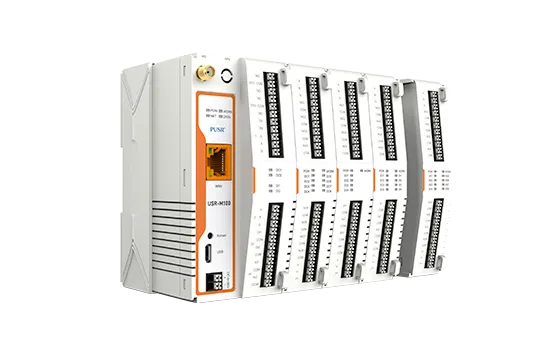
Similar USR-M100 module with connected IO modules
Product description
This devices is sold as ‘Arduino Open Source IoT Gateway’ and previously had the product number USR-M100-ARD.
Thanks to the expansion slot, the base module can easily be expanded with multiple IO modules.
It uses a ESP32-WROVER-IE-N4R8 as it’s main processor and can be easy flashed
to ESPHome with factory supplied USB to UART cable.
External interfaces
The module has the following external interfaces:
- 9-36V DC Power Supply input
- UART programming port (Marked as USB)
- External WiFi/Bluetooth antenna
- Ethernet (IP101 chip)
- Combined RS232/485 port
- 1x Digital input
- 2x Digital relay output (Controlled by SN74HC595 chip)
- 1x Analog input(4~20mA)
- Expansion slot
IO expansion modules
IO modules can be connected to the main module via a connector on the side.
This connector supplies power to the IO modules, one UART pin for configuration, and RS485/Modbus for the actual IO control.
On the UART TX pin, the following 12 configuration bytes need te be send (@9600 baud):
| Byte | Description |
|---|---|
| 1 | Start bytes, always 0xDB |
| 2 | This device address, usually 0x00 for the main module. |
| 3 | Next device address, usually 0x01 for the first IO expansion module. |
| 4-7 | Baudrate as 32 bit integer |
| 8 | Data bits, always 8 |
| 9 | Stop bits, usually 1 |
| 10 | Parity; 0: None, 1: Odd, 2: Even |
| 11-12 | CRC16 (Modbus type) |
Each IO module increments bytes 2 and 3, calculates the CRC16, and sends its data to the next module.
The IO modules can be controlled with the
ESPHome Modbus Controller Component.
Follow the
IO module manual
for correct modbus registers and settings.
Watchdog timer
A SGM820B supervisory IC is present that resets the ESP32 in case of undervoltage and also features a watchdog timer.
It requires a regular input pulse from the ESP32 to prevent a reset from being performed.
Without a signal, the watchdog timer will perform a full power reset after approximately 70-80 seconds.
Since the watchdog trigger pin is shared with the UART0 RX pin,
it is important to disable UART logging and don’t leave the USB cable disconnected.
Flashing
A USB cable is supplied from the factory to flash the firmware.
This is not an ordinary USB cable, but a USB to UART adapter.
To flash firmware, the ‘reload’ button must be pressed during power-on.
After releasing the button, you have approximately 70 seconds to
start the firmware update before the watchdog timer triggers a reset.
During programming, the watchdog timer is triggered by the data transfer, preventing a reset during flashing.
GPIO Pinout
| Pin | Interface | Function |
|---|---|---|
| GPIO3 | Watchdog + work led | WDT Trigger |
| GPIO18 | Ethernet | RMII_MDIO |
| GPIO23 | Ethernet | RMII_MDC |
| GPIO0 | Ethernet | RMII_REF_CLK |
| GPIO19 | Ethernet | RMII_TXD0 |
| GPIO22 | Ethernet | RMII_TXD1 |
| GPIO25 | Ethernet | RMII_RX0 |
| GPIO26 | Ethernet | RMII_RX1 |
| GPIO21 | Ethernet | RMII_TXEN |
| GPIO27 | Ethernet | RMII_CRS_DV |
| GPIO5 | Ethernet | PHY_RESET |
| GPIO32 | RS485/232 | TXD |
| GPIO33 | RS485/232 | RXD |
| GPIO12 | RS485/232 | RS485 DE/RE |
| GPIO13 | IO expansion - RS485 | TXD |
| GPIO34 | IO expansion - RS485 | RXD |
| GPIO14 | IO expansion - RS485 | RS485 DE/RE |
| GPIO1 | IO expansion - UART | TXD |
| GPIO4 | SN74HC595 - Relays | DATA |
| GPIO15 | SN74HC595 - Relays | CLOCK |
| GPIO2 | SN74HC595 - Relays | LATCH |
| GPIO35 | Analog input | AI |
| GPIO39 | Digital input | DI |
| GPIO36 | Reload button (pulse) | DI |
Example Configuration
esphome:  name: usr-eg118
esp32:  variant: esp32  framework:    type: esp-idf
psram:  mode: quad  speed: 80MHz  ignore_not_found: false
logger:  baud_rate: 0
api:
ota:  platform: esphome
ethernet:  type: IP101  mdc_pin: GPIO23  mdio_pin: GPIO18  clk:    pin: GPIO0    mode: CLK_EXT_IN  phy_addr: 1  power_pin: GPIO5
output:  - platform: gpio    pin: GPIO3    id: WDT_Trigger
uart:  - id: PUSR_expansion_config    tx_pin: GPIO1    baud_rate: 9600
  - id: PUSR_expansion_rs485    tx_pin: GPIO13    rx_pin: GPIO34    flow_control_pin: GPIO14    baud_rate: 115200
  - id: PUSR_external_rs485    tx_pin: GPIO32    rx_pin: GPIO33    flow_control_pin: GPIO12    baud_rate: 115200
interval:  - interval: 2000ms    then:      - output.turn_on: WDT_Trigger      - delay: 1000ms      - output.turn_off: WDT_Trigger
  - interval: 3000ms    then:      - uart.write:          id: PUSR_expansion_config          data: [0xDB, 0x00, 0x01, 0x00, 0x01, 0xC2, 0x00, 0x08, 0x01, 0x00, 0x3C, 0xD5]
modbus:  - uart_id: PUSR_expansion_rs485    id: PUSR_expansion_modbus    send_wait_time: 10ms    turnaround_time: 5ms
  - uart_id: PUSR_external_rs485    id: PUSR_external_modbus
sn74hc595:  - id: 'sn74hc595_hub'    data_pin: GPIO4    clock_pin: GPIO15    latch_pin: GPIO2    sr_count: 1
switch:  - platform: gpio    name: "DO1"    pin:      sn74hc595: sn74hc595_hub      number: 1  - platform: gpio    name: "DO2"    pin:      sn74hc595: sn74hc595_hub      number: 2
binary_sensor:  - platform: gpio    name: "DI1"    pin:        number: GPIO39        inverted: true  - platform: gpio    name: "Reload"    pin:        number: GPIO36        inverted: true
sensor:  - platform: adc    pin: GPIO35    name: "AI1"
IO Module example
modbus_controller:  - id: PUSR_IO_Module_1    address: 1    modbus_id: PUSR_expansion_modbus    update_interval: 500ms
binary_sensor:  - platform: modbus_controller    modbus_controller_id: PUSR_IO_Module_1    register_type: discrete_input    address: 0    name: "I1.1"
switch:  - platform: modbus_controller    modbus_controller_id: PUSR_IO_Module_1    register_type: coil    address: 0    name: "DO1.1"