
LILYGO T3 LoRa32 V1.6.1
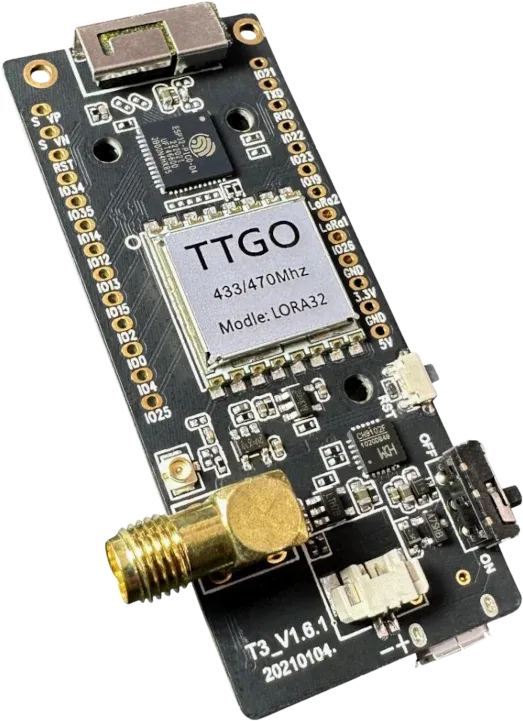
Model reference: T3 LoRa32 V1.6.1
Manufacturer: LILYGO
Product Description
The LILYGO T3 LoRa32 V1.6.1 is a development board featuring an ESP32 microcontroller with integrated WiFi, Bluetooth, and a Semtech SX1276/SX1278 LoRa radio transceiver. It includes a 0.96” OLED display and is designed for IoT applications requiring long-range wireless communication.
Key Features
- ESP32 dual-core processor @ 240MHz
- 4MB Flash memory
- SX1276/SX1278 LoRa radio (433MHz or 868/915MHz variants)
- 0.96” OLED display (128x64)
- WiFi 802.11 b/g/n
- Bluetooth Classic and BLE
- Micro-USB connector
- LiPo battery connector with charging circuit
- SD card slot
- Onboard CP2104 USB-to-UART bridge
GPIO Pinout
LoRa SX127x Pins
| Function | GPIO |
|---|---|
| SPI CLK | GPIO5 |
| SPI MOSI | GPIO27 |
| SPI MISO | GPIO19 |
| CS | GPIO18 |
| RST | GPIO23 |
| DIO0 | GPIO26 |
| DIO2 | GPIO32 |
Display (OLED)
| Function | GPIO |
|---|---|
| SDA | GPIO21 |
| SCL | GPIO22 |
| RST | GPIO16 |
Other Pins
| Function | GPIO |
|---|---|
| Button | GPIO0 |
| LED | GPIO25 |
| Battery ADC | GPIO35 |
Basic Configuration
Minimum configuration required for the LILYGO TTGO T3 LoRa32 V1.6.1:
esphome:  name: "t3-lora32"
esp32:  variant: esp32  cpu_frequency: 240MHZ  framework:    type: esp-idf
logger:
api:
ota:  platform: esphome
wifi:  ssid: !secret wifi_ssid  password: !secret wifi_password
# SPI bus for LoRa radiospi:  clk_pin: GPIO5  mosi_pin: GPIO27  miso_pin: GPIO19
# I2C for OLED displayi2c:  sda: GPIO21  scl: GPIO22  frequency: 400kHz
LoRa Radio Configuration
Complete configuration with LoRa modulation:
# LoRa Radio Configuration (SX1276/SX1278)sx127x:  dio0_pin: GPIO26  cs_pin: GPIO18  rst_pin: GPIO23  pa_pin: BOOST  pa_power: 10  bandwidth: 125_0kHz  crc_enable: true  frequency: 433920000  modulation: LORA  rx_start: true  sync_value: 0x12  preamble_size: 8  spreading_factor: 7  coding_rate: CR_4_6  on_packet:    then:      - lambda: |-          ESP_LOGD("lora", "Received packet RSSI: %.2f dBm, SNR: %.2f dB, Data: %s",                   rssi, snr, format_hex(x).c_str());
# Example button to send LoRa packetbutton:  - platform: template    name: "Send LoRa Packet"    on_press:      then:        - sx127x.send_packet:            data: [0xDE, 0xAD, 0xBE, 0xEF, 0xCA, 0xFE, 0xBA, 0xBE]
FSK Modulation
Configuration for FSK modulation in packet mode:
# FSK Radio Configuration (SX1276/SX1278)sx127x:  dio0_pin: GPIO26  cs_pin: GPIO18  rst_pin: GPIO23  pa_pin: BOOST  pa_power: 10  bitrate: 4800  bitsync: true  crc_enable: true  frequency: 433920000  modulation: FSK  packet_mode: true  payload_length: 8  rx_start: true  sync_value: [0x33, 0x33]  preamble_size: 4  preamble_detect: 2  on_packet:    then:      - lambda: |-          ESP_LOGD("fsk", "Received packet: %s", format_hex(x).c_str());
# Example button to send FSK packetbutton:  - platform: template    name: "Send FSK Packet"    on_press:      then:        - sx127x.send_packet:            data: [0xC5, 0x51, 0x78, 0x82, 0xB7, 0xF9, 0x9C, 0x5C]
OOK Modulation with Remote Transmitter/Receiver
Configuration for OOK modulation in continuous mode using the remote transmitter and receiver components:
# OOK Radio Configuration (SX1276/SX1278)sx127x:  cs_pin: GPIO18  rst_pin: GPIO23  frequency: 433920000  modulation: OOK  packet_mode: false  bitsync: false  rx_start: true  bandwidth: 50_0kHz  rx_floor: -85  pa_pin: BOOST  pa_power: 10
# Remote receiver on DIO2remote_receiver:  pin:    number: GPIO32    allow_other_uses: true    mode:      input: true      output: true      pullup: true      open_drain: true  filter: 50us  dump: raw  idle: 1ms
# Remote transmitter on DIO2 (shared with receiver)remote_transmitter:  pin:    number: GPIO32    allow_other_uses: true    mode:      input: true      output: true      pullup: true      open_drain: true  eot_level: false  carrier_duty_percent: 100%  on_transmit:    then:      - sx127x.set_mode_standby      - remote_transmitter.digital_write: false      - sx127x.set_mode_tx  on_complete:    then:      - sx127x.set_mode_standby      - remote_transmitter.digital_write: true      - sx127x.set_mode_rx
# Example button to transmit OOK signalbutton:  - platform: template    name: "Transmit OOK"    on_press:      then:        - remote_transmitter.transmit_raw:            code: [614, -614, 600, -614, 614, -614, 601, -614]
OLED Display Configuration
Configuration to use the onboard 0.96” OLED display:
# OLED Displaydisplay:  - platform: ssd1306_i2c    model: "SSD1306 128x64"    address: 0x3C    lambda: |-      it.printf(0, 0, id(display_font), "T3 LoRa32");      it.printf(0, 16, id(display_font), "V1.6.1");      it.printf(0, 32, id(display_font), "%.1f dBm", id(wifi_signal_db).state);
font:  - file: "gfonts://Roboto"    id: display_font    size: 14
sensor:  - platform: wifi_signal    id: wifi_signal_db    name: "WiFi Signal"    update_interval: 60s
Battery Monitoring
Configuration to monitor LiPo battery voltage:
sensor: - platform: adc pin: GPIO35 name: "Battery Voltage" attenuation: 12db filters: - multiply: 2.0 # Voltage divider correction update_interval: 60sSD Card
The board includes an SD card slot on the following pins:
| Function | GPIO |
|---|---|
| CS | GPIO13 |
| MOSI | GPIO15 |
| MISO | GPIO2 |
| CLK | GPIO14 |