
Citilab ED1
Device Type:
Electrical Standard:
Board:
Difficulty:Plug-n-flash (2/5)
Project URL:https://github.com/glifocat/ed1-hoas
The ED1 is an educational development board based on the ESP32, created by Citilab Edutec. It is designed to teach embedded systems, programming, and IoT.
It features a built-in 1.44” TFT display, capacitive touch buttons, sensors (light, temperature), and expansion ports for controlling stepper motors (28BYJ-48) and WS2812 LED matrices.
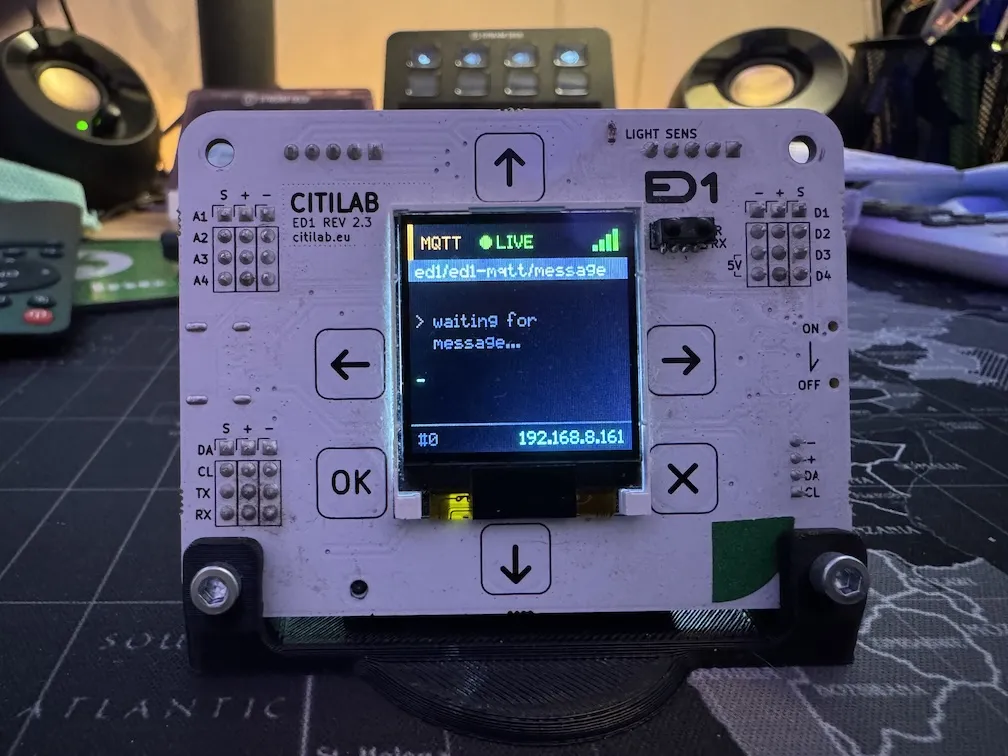
Features
- MCU: ESP32-SIP (Dual-core 240MHz, WiFi, BLE)
- Display: 1.44” TFT LCD (ST7735, 128x128 pixels)
- Input: 6 Capacitive Touch Buttons (Up, Down, Left, Right, OK, X)
- Audio: Passive Buzzer with amplifier (PAM8301)
- Sensors:
- Light Sensor (ALS-PT19-315C)
- IR Receiver (38kHz)
- Internal Temperature & WiFi Signal
- Power: USB-C (5V) and Li-Ion Battery (16340) charger
- Expansion:
- Stepper Motors: I2C Expander (MCP23009) + ULN2004A drivers for 2x 28BYJ-48
- LED Matrix: Dedicated port for WS2812 32x8 matrix
- I2C/UART: Grove connector and pin headers
Configuration
The following configuration enables the display, buttons, buzzer, and basic sensors.
Note: For advanced features like stepper motors (which use direct I2C register manipulation via MCP23009) or complex display layouts, consider using external packages or custom components as seen in the project repository.
# ==============================================================================# Citilab ED1 - Minimal ESPHome Configuration# ==============================================================================substitutions:  name: ed1-board  friendly_name: ED1 Board
esphome:  name: ${name}  friendly_name: ${friendly_name}  name_add_mac_suffix: true  project:    name: citilab.ed1    version: "1.0"
esp32:  board: esp32dev  framework:    type: arduino
logger:  level: INFO
api:
ota:  - platform: esphome
wifi:  id: wifi_component  # Enable fallback hotspot (captive portal) in case wifi connection fails  ap:    ssid: "ED1-Fallback"
captive_portal:
# ==============================================================================# Hardware Buses# ==============================================================================
spi:  clk_pin: GPIO18  mosi_pin: GPIO23  miso_pin: GPIO19
i2c:  sda: GPIO21  scl: GPIO22  scan: true  id: bus_i2c
# ==============================================================================# Fonts (using Google Fonts - no external files needed)# ==============================================================================
font:  - file: "gfonts://Roboto"    id: font_large    size: 20  - file: "gfonts://Roboto"    id: font_medium    size: 14  - file: "gfonts://Roboto"    id: font_small    size: 10
# ==============================================================================# TFT Display (ST7735 128x128)# ==============================================================================
display:  - platform: st7735    id: internal_display    cs_pin: GPIO5    dc_pin: GPIO9    reset_pin: GPIO10    rotation: 0    model: "INITR_GREENTAB"    device_width: 128    device_height: 128    col_start: 2    row_start: 3    update_interval: 1s    lambda: |-      // Colors      auto BLACK = Color(0, 0, 0);      auto WHITE = Color(255, 255, 255);      auto GREEN = Color(0, 255, 0);      auto GRAY = Color(100, 100, 100);
      it.fill(BLACK);
      // Title      it.print(64, 20, id(font_large), GREEN, TextAlign::CENTER, "ED1");
      // IP Address (if connected)      if (id(wifi_component).is_connected()) {         it.print(64, 50, id(font_small), WHITE, TextAlign::CENTER, id(wifi_ip).state.c_str());      } else {         it.print(64, 50, id(font_small), GRAY, TextAlign::CENTER, "Connecting...");      }
      // Separator      it.horizontal_line(10, 65, 108, GRAY);
      // Sensor readings      if (!std::isnan(id(cpu_temp).state)) {        it.printf(64, 75, id(font_small), WHITE, TextAlign::CENTER, "CPU: %.1fC", id(cpu_temp).state);      }
      if (!std::isnan(id(light_sensor).state)) {        it.printf(64, 90, id(font_small), WHITE, TextAlign::CENTER, "Light: %.0f%%", id(light_sensor).state);      }
      // WiFi signal      if (!std::isnan(id(wifi_signal_sensor).state)) {        it.printf(64, 105, id(font_small), GRAY, TextAlign::CENTER, "WiFi: %.0fdBm", id(wifi_signal_sensor).state);      }
# ==============================================================================# Buzzer# ==============================================================================
output:  - platform: ledc    pin: GPIO26    id: buzzer_output
rtttl:  output: buzzer_output  id: buzzer
switch:  - platform: template    name: "Buzzer Test"    id: buzzer_switch    turn_on_action:      - rtttl.play: "beep:d=4,o=5,b=100:c"    turn_off_action:      - rtttl.stop
# ==============================================================================# Touch Buttons# ==============================================================================
esp32_touch:  setup_mode: false
binary_sensor:  - platform: esp32_touch    name: "Button Up"    id: btn_up    pin: GPIO4    threshold: 500    on_press:      - rtttl.play: "beep:d=16,o=5,b=140:c"
  - platform: esp32_touch    name: "Button Down"    id: btn_down    pin: GPIO13    threshold: 500    on_press:      - rtttl.play: "beep:d=16,o=5,b=140:d"
  - platform: esp32_touch    name: "Button Left"    id: btn_left    pin: GPIO2    threshold: 500    on_press:      - rtttl.play: "beep:d=16,o=5,b=140:e"
  - platform: esp32_touch    name: "Button Right"    id: btn_right    pin: GPIO27    threshold: 500    on_press:      - rtttl.play: "beep:d=16,o=5,b=140:f"
  - platform: esp32_touch    name: "Button OK"    id: btn_ok    pin: GPIO15    threshold: 500    on_press:      - rtttl.play: "ok:d=8,o=5,b=160:c,e,g"
  - platform: esp32_touch    name: "Button X"    id: btn_x    pin: GPIO14    threshold: 900    on_press:      - rtttl.play: "alert:d=8,o=5,b=180:c,c,c"
# ==============================================================================# Sensors# ==============================================================================
sensor:  - platform: wifi_signal    name: "WiFi Signal"    id: wifi_signal_sensor    update_interval: 60s
  - platform: uptime    name: "Uptime"    id: uptime_sensor
  - platform: internal_temperature    name: "CPU Temperature"    id: cpu_temp
  - platform: adc    pin: GPIO34    name: "Light Level"    id: light_sensor    attenuation: 12db    update_interval: 5s    unit_of_measurement: "%"    filters:      - multiply: 30.3
text_sensor:  - platform: wifi_info    ip_address:      name: "IP Address"      id: wifi_ip    ssid:      name: "WiFi SSID"